Ease Is Sunsetting: A Broker's Migration Playbook (and How to Choose What's Next)

If your agency still runs groups on Ease, you've probably had some version of this conversation with yourself lately: "We know it's ending. We'll deal with it after renewals." That's a reasonable instinct. It's also how a manageable project turns into a scramble.
On June 3, 2026, Employee Navigator, which acquired Ease in April 2023, announced a two-phase sunset of the Ease platform. The first date is now less than two months away. This playbook lays out what's actually changing, a sequence for moving your book without touching a group mid-enrollment, and a fair way to decide where your groups should land.
What's Actually Changing, and When
There are two dates to build your plan around.
January 1, 2027: No new companies
Starting January 1, 2027, new companies can no longer be added to Ease, and the "Add Company" feature will be disabled. Employee Navigator has been clear that existing companies aren't affected by this phase. You can keep renewing and servicing your current Ease groups into 2027.
The practical impact: any group you sell or pick up after January 1 needs a home that isn't Ease. If you have Q1 new business in the pipeline, that decision is due now, not in the spring.
July 1, 2027: Read-only
Starting July 1, 2027, Ease moves to read-only mode. Integrations and customer support for Ease end on that date. Employee Navigator's announcement says brokers, HR teams, and employees will keep access to historical data and reporting tools.
One honest caveat: some of Employee Navigator's other migration materials describe employee access after July 1 differently than the announcement does. Exactly what employees will be able to see after July 1 is unclear right now, so confirm it with Employee Navigator before you tell clients anything definitive. For planning purposes, assume that anything you need to keep working, including carrier feeds, payroll connections, and day-to-day changes, must be running somewhere else before July 1.
The upgrade path Employee Navigator offers
It's worth saying plainly: Employee Navigator isn't leaving Ease users stranded. It offers an upgrade path from Ease to its own platform, including a migration tool, and it's re-contracting Ease brokers. For plenty of agencies, upgrading to Employee Navigator will be the simplest move, and that's a legitimate choice.
The sunset is still a natural moment to ask a bigger question. You're going to touch every group anyway. Is enrollment the only thing you want your next platform to do?
The Mistake to Avoid: Moving a Group at the Wrong Moment
The biggest risk in leaving Ease isn't the new platform. It's timing. A group that moves in the middle of open enrollment, or right before a renewal, is the group that ends up with missed elections, mismatched deductions, and an HR director who stops returning your calls.
So the rule for this whole playbook is simple: every group moves at a quiet point in its own plan year. Not all at once, and never mid-enrollment. If you want a deeper look at why the calendar matters more than the software, our guide to switching benefits platforms mid-year walks through it.
A Four-Phase Ease Migration Playbook
Phase 1 (now through December 2026): Finish OE where it is and take inventory
Don't move anything during open enrollment. Close out current enrollments in Ease, confirm your carrier and payroll feeds are accurate, and use the downtime between client calls to build a simple inventory of your Ease book:
- Every group on Ease, with its renewal month and open enrollment window
- Carrier connections and file schedules for each group
- Payroll and HRIS connections, including deduction codes
- Who your HR contact is and how hands-on they are
- Any group with unusual eligibility rules, classes, or contribution setups
This inventory becomes your migration schedule. It also tells you which groups will be easy to move and which ones need extra time.
Phase 2 (January 2027): Start new groups on your new platform
Because new companies can't be added to Ease after January 1, newly sold groups go straight onto your next platform. This is the lowest-risk way to learn a new system: there's no historical data to move and no existing habits to break. Treat your first few new groups as your training ground.
Phase 3 (early to mid 2027): Move existing groups in waves
Group your book by renewal month and move one wave at a time. A group is ready to move when its open enrollment has closed, its elections are confirmed, and its feeds are clean, and well before its next renewal.
For each group in a wave:
- Export the census, dependents, current elections, plan and rate setup, and contribution rules.
- Rebuild the group on the new platform and have the HR contact review it.
- Reconnect carrier and payroll connections, and run them in parallel until the first files from the new platform are verified.
- Send employees clear instructions on how to log in to the new system.
- Only then turn off the old process for that group.
Start with your simplest, most cooperative groups. You'll find the gaps in your process on a group that forgives you.
Phase 4 (before July 1, 2027): Finish and archive
Aim to have every active group off Ease well before July 1, not the week before. Integrations and support end that day, and you don't want to be troubleshooting a carrier file with nobody to call. Before the read-only date, export and store the records you'll want later: past elections, signed documents, ACA history, and the reports your clients rely on. Even if read-only access continues, your own archive is the one you control.
How to Choose What's Next
Most of the Ease alternatives brokers are looking at will handle enrollment. That's table stakes. The more useful question is what else your agency needs from the system you'll live in for the next several years. Here's a fair set of criteria to score any option against, including Employee Navigator and Administr.
Effort to move
How much work is the migration itself? Ask each vendor what data they can import, who does the setup, and how long a typical group takes. An upgrade path inside the same family of products can be easier on day one, so weigh that honestly.
Integrations
List the carriers and payroll systems your groups actually use, and ask each vendor to confirm them by name. Don't accept a logo wall. Ask how connections are tested before cutover.
What happens around enrollment
This is where platforms differ most. Do you want your CRM, quoting and proposals, renewal pipeline, client marketing, and compliance tracking in the same login as enrollment, or are you happy keeping those in separate tools? Neither answer is wrong, but it should be a decision, not an accident.
Compliance support
ACA tracking and 1094-C/1095-C reporting season starts right as many groups finish renewals. Ask how each platform supports ACA reporting and whether compliance deadlines show up somewhere your team will actually see them.
Pricing you can predict
Ask for pricing in writing, with the billing term spelled out, and ask what changes as your book grows. For reference, Administr's pricing is a flat monthly subscription by tier: Standard is $499/month billed annually or $599/month month-to-month, Premium is $899/month billed annually or $999/month month-to-month, and Elite is $1,899/month billed annually or $1,999/month month-to-month. Enterprise pricing is custom.
Where Administr Fits
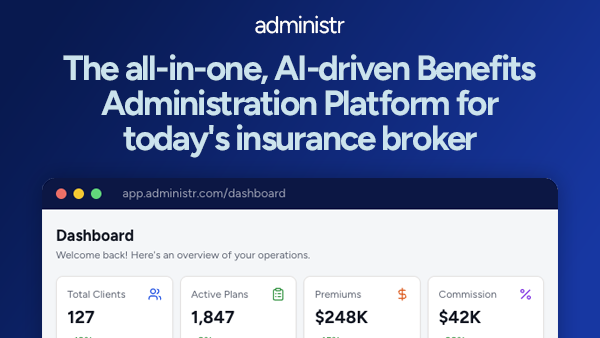
Administr was built by a benefits agency owner for agencies that want more than an enrollment system. It brings benefits administration, quoting and proposals, a broker CRM, compliance tools, and client marketing into one platform, with an employee self-service portal for your clients' teams.
The goal is to give your team time back, not to add another tool to manage. Agencies running on Administr save 40+ hours a month on manual admin work, about $1,200 a month in staff time, and typically see payback in under 90 days. If you want the side-by-side, our Administr vs. Ease comparison covers features, the sunset timeline, and a pre-switch checklist. And if you're planning the move in waves, the free Ease Migration Guide includes a wave planner and a data readiness checklist you can fill in group by group.
A Quick Pre-January Checklist
If you only do five things before January 1, do these:
- Build the inventory of your Ease groups, renewal months, and connections.
- Decide where new groups sold after January 1 will go.
- Shortlist two or three platforms and score them on the criteria above.
- Pick your first wave of simple, cooperative groups for early 2027.
- Put a reminder on your calendar for an archive check in the spring, well ahead of July 1.
Frequently Asked Questions
When does Ease stop accepting new companies?
Starting January 1, 2027, new companies can no longer be added to Ease and the "Add Company" feature is disabled, according to Employee Navigator's June 3, 2026 announcement. Existing Ease groups are not affected by this phase and can keep being renewed and serviced into 2027.
What happens to Ease on July 1, 2027?
Starting July 1, 2027, Ease moves to read-only mode, and its integrations and customer support end. Employee Navigator's announcement says brokers, HR teams, and employees keep access to historical data and reporting, but its other materials describe employee access differently, so confirm the details with Employee Navigator.
Do I have to move my Ease groups to Employee Navigator?
No. Employee Navigator offers Ease users an upgrade path to its platform, and for many agencies that is a reasonable choice. You can also choose another platform. Either way, plan each group's move around its open enrollment and renewal dates.
When is the best time to move a group off Ease?
Move each group at a quiet point in its plan year: after its open enrollment has closed and its elections and feeds are confirmed, and well before its next renewal. Never move a group in the middle of open enrollment, and aim to finish well before July 1, 2027.
How can I get help planning an Ease migration?
Administr offers a free Ease migration consult. We review your book, renewal calendar, and connections and help you build a wave plan that keeps open enrollment and renewals on track. Book one at administr.com/schedule-a-call/.
Talk It Through Before You Commit
You don't have to pick a platform today. But you do need a plan before January 1, and it's easier to build one with someone who has thought through the edge cases.
Book a free Ease migration consult. We'll look at your book, your renewal calendar, and your connections, and help you map out a wave plan that keeps open enrollment and renewals on track, whichever platform you end up choosing. Schedule your free migration consult.

About the author
Joshua HuppFounder of Administr
Joshua Hupp is the founder of Administr and has spent nearly 20 years in the benefits industry. He built Administr for his own agency after experiencing the frustration of outdated processes and disconnected tools. His focus is making employee benefits simpler for agency owners, employers, and employees.